

ERP vs Accounting Software: What’s the Difference?
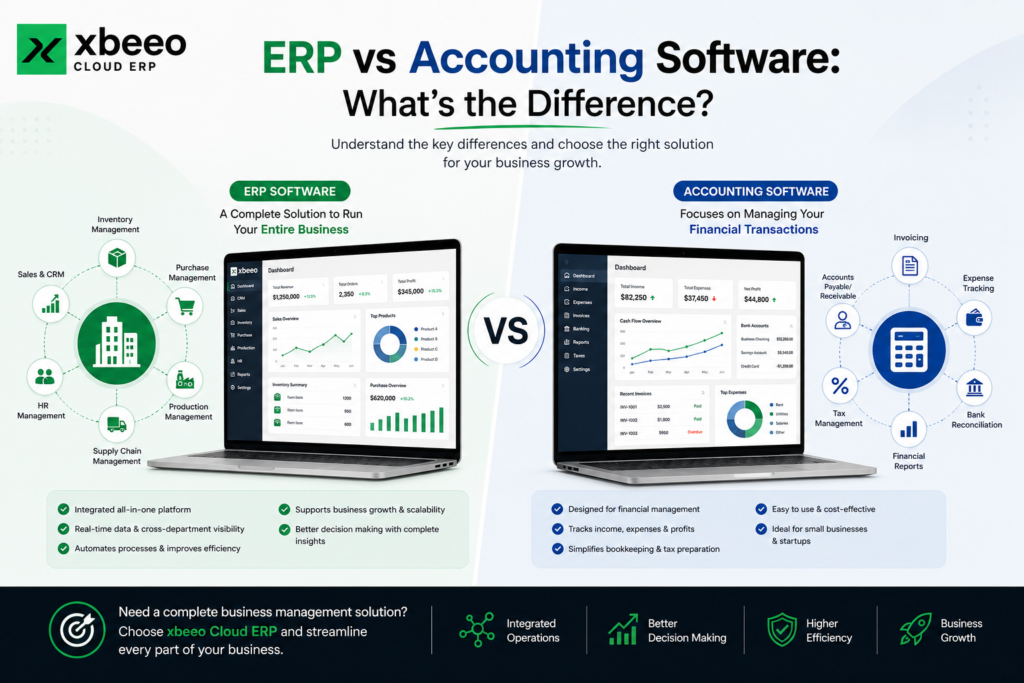
This is where the difference between accounting software and ERP becomes important. Accounting software focuses mainly on financial management, while ERP connects finance with the wider business. Instead of keeping operational information in separate applications, an ERP platform brings major business functions together and allows data to move between them through connected workflows.
For businesses comparing a cloud based ERP provider in Pakistan, understanding this distinction is essential before choosing a system. The right solution should match the company’s size, operational complexity, industry requirements, and plans for future growth.
This guide explains what accounting software and ERP software do, how they differ, when accounting software may still be enough, and when moving to ERP becomes a practical choice for a growing business.
What Is Accounting Software?
Accounting software is designed primarily to manage a company’s financial activities. It helps businesses record transactions, organize accounts, track income and expenses, prepare invoices, and maintain financial records. For organizations with straightforward operations, these capabilities may cover most of their day-to-day financial requirements.
Core Purpose of Accounting Software
The main purpose of accounting software is to keep financial information organized and accurate. It records sales, purchases, payments, expenses, receivables, payables, and other accounting transactions. Finance teams can use this information to maintain books, reconcile accounts, and prepare financial statements without relying on manual calculations.
Common Accounting Functions
Most accounting systems provide tools for invoicing, accounts payable, accounts receivable, general ledger management, bank reconciliation, tax records, and financial reporting. These functions help businesses maintain financial discipline and give owners a clearer understanding of their income, expenses, and overall financial position.
Who Benefits Most from Accounting Software?
Accounting software is often suitable for small businesses with limited departments and relatively simple workflows. A company that mainly needs reliable bookkeeping, invoicing, expense tracking, and financial reporting may not require a broader enterprise platform. In such cases, accounting software can provide the financial controls needed without unnecessary operational complexity.
Where Accounting Software Has Limitations
The main limitation appears when a business needs to connect finance with other departments. Accounting software may not provide comprehensive tools for inventory, production, procurement, warehouse management, human resources, customer management, or complex operational workflows. Businesses may then depend on additional applications, creating separate data sources and more manual coordination.
What Is ERP Software?
ERP software is a broader business management system that connects multiple departments within one platform. While accounting software focuses mainly on financial activities, ERP links finance with inventory, procurement, sales, human resources, manufacturing, customer management, and other operational functions. This creates a connected environment where information can move between departments without repeated manual entry.
Integrated Business Management
ERP brings different business functions into a shared system instead of keeping each department in isolation. A sales transaction can affect inventory, finance, and order processing without requiring employees to update several separate applications. This connected structure improves coordination and gives management a clearer view of overall business activity.
Core ERP Modules
ERP platforms commonly include finance and accounting, inventory, procurement, sales, customer relationship management, human resources, manufacturing, warehouse management, project management, and reporting. Businesses can select the modules relevant to their operations and expand the system as their requirements become more complex.
Centralized Business Data
One of the defining features of ERP is a centralized database. Departments access the same business information rather than maintaining separate records. This reduces duplicate data, improves consistency, and makes it easier for managers to understand what is happening across the organization.
Cross-Department Workflows
ERP connects business processes from beginning to end. For example, a customer order can trigger inventory checks, warehouse processing, invoicing, and financial updates within the same workflow. These connections reduce handoffs between teams and help businesses complete routine operations with greater speed and control.
ERP vs Accounting Software: Key Differences
The main difference between ERP and accounting software is their scope. Accounting software primarily manages financial transactions and records, while ERP connects financial management with broader business operations. Understanding this distinction helps businesses choose technology based on their current processes, operational complexity, and plans for future growth.
Scope of Business Management
Accounting software focuses mainly on financial activities such as invoicing, bookkeeping, payments, expenses, and financial reporting. ERP covers these functions while also managing inventory, procurement, sales, human resources, production, warehousing, and other operational processes through one integrated platform.
Department Integration
Accounting software can manage finance effectively but may require separate systems for other departments. ERP connects multiple business functions so information can flow between teams automatically. This reduces manual coordination and helps departments work from the same data instead of maintaining isolated records.
Automation Capabilities
Both systems can automate routine financial tasks, but ERP extends automation across the wider organization. Purchase approvals, inventory updates, order processing, production workflows, employee management, and financial entries can operate as connected processes. This reduces repetitive work and creates more consistent business workflows.
Inventory and Supply Chain Control
Accounting software can record the financial value of inventory, but it may not provide comprehensive operational control over stock movement. ERP can manage purchasing, receiving, warehouse activities, stock transfers, replenishment, and related financial transactions within connected workflows. This gives businesses greater control over physical and financial inventory.
Reporting and Business Visibility
Accounting software provides financial statements and accounting reports. ERP combines financial information with operational data, allowing management to review sales, inventory, procurement, production, workforce activity, and financial performance together. This broader visibility supports more informed decisions across the organization.
Scalability
Accounting software may remain suitable when business processes are simple and financial management is the primary requirement. ERP becomes more valuable as departments, locations, products, employees, and operational workflows increase. A scalable ERP platform can support this added complexity without requiring separate systems for every new business function.
When Accounting Software May Be Enough
ERP is not automatically the right choice for every business. Some organizations have straightforward operations where financial management is the main requirement. In these situations, accounting software can provide the necessary tools without adding the complexity, implementation effort, or wider operational features of an ERP platform.
Small Business Operations
A small business with a limited team and simple workflows may only need bookkeeping, invoicing, expense tracking, and financial reporting. If inventory is modest and departments do not require extensive coordination, accounting software can handle core financial responsibilities effectively.
Basic Financial Requirements
Businesses that mainly need to record income, expenses, payments, receivables, and payables may not require a complete enterprise platform. Accounting software can provide essential financial controls while keeping everyday processes relatively simple for business owners and finance teams.
Limited Inventory Needs
Companies with a small product range and straightforward stock requirements may manage inventory adequately through accounting software or a separate basic stock system. When there are few warehouses, limited product movement, and simple purchasing requirements, a full ERP platform may not yet be necessary.
Few Departments or Users
A business with a small workforce and limited departmental separation may not benefit significantly from extensive system integration. When the same employees handle multiple responsibilities and operational processes remain manageable, accounting software can provide a practical solution without introducing unnecessary complexity.
When the Situation Changes
Accounting software may remain suitable until operational complexity begins to increase. Rapid growth, multiple locations, larger inventories, manufacturing activities, complex procurement, or expanding teams can create requirements that exceed basic financial management. At that stage, comparing ERP with accounting software becomes an important technology decision for the business.
When Your Business Needs ERP
The need for ERP usually appears when financial management is no longer the only challenge. As operations become broader, businesses need stronger connections between finance, inventory, procurement, sales, employees, customers, and other departments. At this stage, relying on separate applications can create unnecessary work and make it harder for management to understand overall business performance.
Multiple Departments Operate Separately
When finance, sales, procurement, inventory, and operations maintain different systems, information becomes fragmented. Employees may need to transfer records manually or request updates from other teams before completing routine tasks. An ERP platform connects these departments, allowing information to move through shared workflows.
Inventory Is Difficult to Control
Growing product ranges and higher transaction volumes make inventory harder to monitor with basic accounting tools. Businesses may need stock transfers, warehouse management, reorder planning, batch tracking, or multi-location control. ERP brings these activities together with purchasing and financial records for a more complete inventory process.
Manual Processes Are Increasing
Repeated data entry, spreadsheet updates, approval emails, and manual reconciliation consume employee time. When these activities become part of everyday operations, the business may benefit from broader automation. ERP can connect related tasks so information entered in one process can update other relevant business functions automatically.
Management Needs Real-Time Visibility
Leadership may eventually need more than financial statements to understand business performance. They may want to see sales activity, stock positions, purchasing status, operational costs, employee information, and customer activity together. ERP provides a broader operational view that helps managers evaluate the business from multiple perspectives.
Business Growth Has Increased Complexity
Expansion often introduces new branches, products, employees, customers, suppliers, and operational processes. Software that worked well at an earlier stage may become difficult to maintain as complexity rises. Businesses considering cloud based ERP services in Pakistan should assess whether their current systems can support future growth without creating additional data silos or administrative work.
Cost and Implementation Considerations
The price of software is only one part of the decision between accounting software and ERP. Businesses should also consider implementation effort, employee training, data migration, customization, support, and the long-term value the system can create. A lower initial price does not always mean a lower total cost over the life of the software.
Software Investment
Accounting software usually requires a smaller initial investment because it focuses on a narrower set of functions. ERP can involve a larger investment because it connects multiple departments and business processes within one platform. The right choice depends on whether the organization needs financial management alone or broader operational integration.
Implementation Requirements
Accounting software can often be configured and used with limited preparation. ERP implementation usually requires more planning because existing workflows, business rules, records, and departmental processes must be reviewed before deployment. Proper implementation helps ensure the system reflects how the business actually operates.
Employee Training
A broader ERP platform introduces more functions and workflows, so employees may need structured training before using the system confidently. Training helps staff understand their responsibilities, follow standardized processes, and use relevant modules correctly. Better user adoption can improve the return on the organization’s technology investment.
Long-Term Business Value
Businesses should evaluate technology according to the problems it solves, not only its purchase price. ERP can reduce duplicate work, connect departments, improve operational visibility, and support growth. When these improvements reduce administrative effort and operational inefficiencies, the broader platform may provide greater long-term value than a basic accounting system.
How XBEEO Helps Businesses Choose the Right System
Choosing between accounting software and ERP depends on the complexity, size, and future plans of the business. At XBEEO, we help organizations evaluate their operational requirements before recommending a suitable ERP approach. Our goal is to ensure businesses invest in technology that solves real operational challenges rather than adding unnecessary complexity.
Business-Focused ERP Configuration
Every company has different workflows, reporting needs, and departmental structures. Our team reviews existing processes before configuring the ERP system, helping ensure finance, inventory, procurement, sales, human resources, and other functions work together according to the organization’s requirements.
Integrated Business Modules
An ERP system becomes more valuable when its modules operate as connected processes. We integrate relevant business functions so information can move between departments without repeated manual entry. This creates greater consistency while helping employees complete daily tasks more efficiently.
Scalable Cloud Infrastructure
A system that works for a small operation may not remain suitable after significant growth. Our cloud ERP solutions support additional users, departments, locations, and business processes as requirements evolve. This allows organizations to expand without replacing their core management system each time operations become more complex.
Implementation and Ongoing Support
Moving from accounting software to ERP requires careful planning, data preparation, employee training, and workflow configuration. We support businesses throughout implementation and continue providing technical assistance after deployment. This helps users adapt to the new system while ensuring the platform continues to support changing business needs.
ERP for Growing Businesses in Lahore
Businesses in Lahore operate across manufacturing, retail, distribution, services, education, healthcare, and e-commerce. As operations expand, basic accounting tools may no longer provide enough control over inventory, procurement, employees, customers, and daily workflows. ERP in Lahore gives growing organizations a way to connect these functions through one integrated management platform.
Understanding Local Business Requirements
Businesses in Lahore may have different operational needs based on their industry, workforce, customer base, and supply chain structure. A suitable ERP approach should reflect these requirements rather than forcing every organization into the same workflow. Understanding local operations is important when deciding which modules and features are actually necessary.
Supporting Multiple Locations
Growth often brings additional branches, warehouses, offices, or production facilities. Managing each location through separate systems can create inconsistent records and reporting gaps. ERP allows businesses to manage multiple locations through one centralized environment while maintaining location-specific information and company-wide visibility.
Connecting Finance With Operations
Accounting remains important, but financial results are influenced by what happens across the rest of the business. ERP connects financial records with sales, purchasing, inventory, and other operational activities. This gives management a broader understanding of how day-to-day operations affect revenue, costs, cash flow, and profitability.
Preparing for Future Expansion
A growing business should avoid selecting software that only solves today’s problems. An ERP platform can provide the structure needed to add users, departments, branches, products, and operational processes over time. This reduces the need for repeated system changes and gives the organization a more stable foundation for future expansion.
Best Practices When Moving from Accounting Software to ERP
Moving from accounting software to ERP is a significant operational change. Businesses should prepare before deployment rather than treating the project as a simple software replacement. Clear planning, accurate data, employee involvement, and phased implementation can make the transition smoother and help the organization gain more value from the new system.
Follow these recommended practices:
- Review existing accounting and business workflows.
- Clean financial and operational data.
- Identify departments that need integration.
- Define clear ERP implementation objectives.
- Involve key employees during planning.
- Train finance and operational teams.
- Introduce complex modules in phases.
- Test important workflows before deployment.
A structured transition helps businesses avoid unnecessary disruption while giving employees time to understand new processes. It also makes it easier to measure whether the ERP system is improving efficiency, data accuracy, and coordination across the organization.
Choosing the Right ERP for Your Business
Choosing an ERP system should begin with your business needs rather than a list of software features. The right platform should solve current operational problems, connect the departments that need to work together, and remain useful as the organization grows. Comparing providers carefully can prevent costly implementation problems later.
Understand Your Industry Requirements
Different industries manage different processes, so ERP requirements vary widely. A manufacturer may need production and inventory controls, while a distributor may focus more on procurement and warehouse management. Identify the workflows that matter most to your business before selecting the platform.
Identify Required Modules
Not every business needs every ERP module from day one. Determine whether you require finance, inventory, procurement, sales, human resources, manufacturing, customer management, warehouse control, or project management. Selecting relevant modules keeps implementation focused while leaving room for future expansion.
Check Integration and Scalability
Your ERP should connect with the systems and processes your business already uses. It should also support additional users, locations, products, and departments as operations expand. A scalable platform reduces the likelihood of replacing your core system again after a few years of growth.
Evaluate Implementation and Support
Software alone does not guarantee a successful ERP project. Review the provider’s implementation process, training approach, customization capabilities, technical support, and post-deployment services. Businesses considering the best cloud based ERP company in Pakistan should evaluate the complete partnership rather than choosing a provider based only on software features or initial price.
ERP vs Accounting Software: What’s the Difference in Pakistan?
Choosing business software can feel confusing when accounting software and ERP systems appear to offer some of the same features. Both can help you manage financial information, improve records and reduce manual work, but they are designed for different levels of business management.
The key difference is scope. Accounting software is primarily built around financial transactions, while an ERP system connects finance with wider business operations such as inventory, sales, procurement, manufacturing and human resources.
For businesses looking for an ERP solution provider in Pakistan, understanding this difference is essential before investing in a system. The right choice depends on how your business operates today, how much coordination you need between departments and where you expect the business to go next.
Accounting Software: Focused on Financial Management
Accounting software is designed mainly to record, organise and manage financial transactions. It can help businesses maintain accounts, track income and expenses, prepare invoices and monitor financial information.
For a small business with relatively straightforward operations, accounting software may be enough. If your main requirement is keeping financial records organised, there may be little reason to introduce a much broader business management platform.
Typical accounting functions include:
- Recording sales and purchases
- Managing income and expenses
- Creating invoices
- Tracking financial transactions
- Maintaining accounting records
- Supporting financial reporting
The limitation becomes clearer when your business starts relying on several departments and operational processes. Your finance team may have the accounting data, while the inventory team maintains separate records and the procurement team works through another process.
That separation can make it harder to get one clear picture of what is happening across the business.
ERP Software: Connecting the Whole Business
An ERP system takes a broader approach. Instead of concentrating mainly on finance, it brings multiple business functions into one connected environment.
A business considering a Cloud Based ERP provider in Pakistan may be looking for a system that can support operations beyond accounting. ERP software can connect financial information with inventory, sales, procurement, manufacturing, HR and business reporting.
For example, a sale can affect inventory, customer records and financial information at the same time. Rather than requiring each department to update separate systems, an ERP can help create a more connected workflow.
This is one of the biggest differences between accounting software and ERP software: accounting software records financial activity, while ERP software can connect financial activity with the operational activity that creates it.
ERP vs Accounting Software: A Practical Comparison
The easiest way to understand the difference is to look at what each system is intended to manage.
Accounting software generally focuses on:
- Financial transactions
- Expenses and income
- Invoicing
- Accounting records
- Financial reporting
ERP software can extend into:
- Finance and accounting
- Inventory
- Sales and customer management
- Procurement
- Manufacturing
- Human resources
- Analytics and reporting
This broader scope makes ERP particularly relevant when different departments need to work with connected information.
For example, imagine a company receives an order for products. In a basic accounting setup, the financial transaction may be recorded separately from inventory and operational processes. With an ERP system, the order can form part of a connected business workflow.
That wider view is why businesses researching an ERP solution provider in Pakistan should evaluate more than accounting features. They should consider whether the platform can support the business processes that sit around finance.
When Does a Business Need an ERP Instead of Accounting Software?
There is no universal point at which every business must move from accounting software to ERP. The decision should be based on operational complexity rather than business size alone.
A business may start thinking about ERP when several departments need access to related information, manual data entry is increasing or separate systems are becoming difficult to coordinate.
For instance, if inventory records, purchasing activity and financial information are maintained independently, employees may spend unnecessary time checking and reconciling information.
A business may benefit from speaking with an ERP solution provider in Pakistan when it needs a more connected way to manage these processes.
Growing Beyond Basic Accounting
Accounting software can work well when financial management is the main requirement. As operations become more complicated, however, the business may need capabilities that accounting software alone does not provide.
Consider a company that purchases materials, stores stock, sells finished products and needs to monitor production. Finance is only one part of that workflow.
The business may need:
- Inventory visibility
- Procurement management
- Sales coordination
- Production management
- Employee information
- Business analytics
- Centralised reporting
At that stage, an ERP system can provide a wider operational framework.
For companies comparing ERP companies in Pakistan, the focus should therefore be on how well each platform fits the organisation’s actual workflows rather than simply comparing accounting features.
Cloud ERP vs Traditional Software
Another consideration is how the ERP system is delivered. A cloud-based ERP system can provide businesses with access to their software through an online environment rather than relying entirely on software installed and maintained on individual computers.
Businesses searching for a cloud based ERP company in Pakistan may be considering cloud technology because their teams need a more flexible way to access business information.
A cloud based ERP system Pakistan solution can be particularly relevant when a business wants its departments to work from a shared system rather than maintaining disconnected applications.
For organisations specifically looking for an ERP solution provider in Lahore, cloud deployment can be an important part of the evaluation. The right platform should match the company’s processes, users and operational requirements rather than being selected simply because it is cloud-based.
Why Cloud ERP Can Change the Comparison
When comparing accounting software with ERP, businesses should consider not just the number of features but how those features work together.
A cloud ERP platform can bring different functions into a connected environment. This can help teams work with shared business information instead of relying on manually transferred records.
For example, procurement information can be connected with inventory requirements, while sales activity can provide useful context for stock planning. Financial information can then sit within the wider business process rather than being isolated from it.
A company evaluating the best cloud based ERP provider in Pakistan should therefore look at the overall business workflow and not just the accounting module.
ERP Can Connect More Than Finance
One of the strongest reasons to consider ERP is the ability to bring multiple operational areas together.
For businesses that need inventory management software Pakistan, inventory is not simply a financial figure. Stock levels can influence purchasing, sales, production and customer fulfilment.
Procurement is similarly connected to other activities. A business considering procurement management software Pakistan may need purchasing processes to work alongside inventory and other operational information.
Manufacturing businesses have even broader requirements. They may need manufacturing ERP software Pakistan capabilities that connect production activity with materials, inventory and other business processes.
This is where ERP moves beyond the role of accounting software. Instead of treating each function as a separate activity, the system can provide a framework for managing connected processes.
Reporting and Business Visibility
Another major difference is the breadth of information available for decision-making.
Accounting software can provide valuable financial reports, but businesses often need operational information alongside financial results.
A company looking for analytics software in Pakistan may want broader visibility into business performance. Similarly, reporting software Pakistan can form part of an ERP environment where information from different areas contributes to a wider view of the organisation.
This matters because a financial result often needs operational context.
If costs are increasing, for example, management may need to look beyond the accounts and examine purchasing, inventory or production activity. A connected ERP environment can make that wider analysis more practical.
For businesses assessing an ERP solution provider in Pakistan, reporting should therefore be considered as part of the complete system rather than treated as an isolated accounting feature.
Which One Is Right for Your Business?
Accounting software can be the sensible option when your requirements are primarily financial and your operations are relatively simple.
ERP becomes more compelling when your business needs multiple departments and processes to work together.
You may want to consider ERP if your business needs:
- Connected financial and operational information
- Centralised inventory management
- Integrated procurement processes
- Sales and customer management
- Manufacturing workflows
- Human resource management
- Broader analytics and reporting
- A cloud-based business management environment
For businesses comparing the Best ERP software in Pakistan, the best choice is not necessarily the platform with the longest feature list. It is the system that fits the organisation’s processes and provides room for those processes to develop.
Making the Move from Accounting to ERP
Moving from accounting software to ERP should be treated as a business decision, not simply a software upgrade.
Start by identifying where your current system works well and where gaps are appearing. Look at the processes that still depend on spreadsheets, duplicate data entry or separate departmental records.
Then consider which functions need to become connected.
For one organisation, inventory may be the biggest issue. For another, procurement or manufacturing may be the main concern. A growing business may need stronger reporting and better coordination between finance and other departments.
This assessment gives you a clearer basis for choosing an ERP solution provider in Pakistan.
The goal should be to create a more connected way of managing the business, rather than replacing accounting software simply for the sake of adopting ERP.
How ERP Supports Different Business Functions
The difference between accounting software and ERP becomes even clearer when you look at what happens outside the finance department.
A business rarely operates as a collection of completely independent activities. Sales affect inventory. Procurement affects stock availability and costs. Manufacturing depends on materials and production planning. Human resources supports the people carrying out those processes. Financial information sits across many of these activities.
An ERP system is designed around these connections.
For a business evaluating an ERP solution provider in Pakistan, this broader approach can make ERP more useful than an accounting platform when operational coordination becomes a priority.
Inventory Management
Inventory is one of the areas where the difference between basic accounting and ERP can become particularly noticeable.
Accounting records can show the financial value of stock, but operational inventory management involves much more. Businesses need to know what stock is available, what has been sold, what needs replenishing and how purchasing or production affects availability.
Dedicated inventory management software Pakistan can therefore form an important part of a wider ERP environment.
When inventory information is connected with sales and procurement, teams can work from a more consistent view of stock. This can reduce the need to move information manually between separate systems.
For a retailer, distributor or manufacturer, that connection can be especially useful because inventory is closely linked to everyday operations.
Sales and Customer Management
Sales management is another area where ERP extends beyond accounting.
An accounting system can record the financial side of a sale, but the wider sales process can involve customer information, orders, follow-ups and other activities.
An ERP environment can bring sales information into the same broader business system.
This means management can look at sales activity alongside inventory, purchasing and financial information instead of viewing each area in isolation.
For a company comparing ERP solution providers in Pakistan, the ability to connect these processes should be part of the assessment.
Procurement and Supply Chain
Purchasing decisions can affect almost every part of a business.
A company needs to understand what it requires, when it needs it and how purchasing activity relates to stock and operations. This makes procurement a natural part of an integrated ERP environment.
Businesses looking for supply chain management software pakistan may therefore be interested in a broader system that connects purchasing with inventory and other business functions.
Similarly, cloud procurement software Pakistan can be considered when an organisation wants procurement processes within a cloud-based business management environment.
Instead of treating purchasing as a standalone activity, ERP can place it within the wider operational workflow.
ERP for Manufacturing Businesses
Manufacturing businesses often have requirements that go well beyond traditional accounting.
A manufacturer needs to manage materials, production activity and inventory while keeping an eye on the financial side of operations. These processes are interconnected.
For businesses considering cloud manufacturing ERP software Pakistan, integration can be particularly valuable because production activity can have a direct relationship with inventory, procurement and sales.
A manufacturing business may need to understand:
- What materials are available
- What materials may need to be purchased
- What production activity is taking place
- How finished products affect inventory
- How operational activity relates to sales
- How the wider process affects financial information
This is a very different requirement from simply recording transactions.
Businesses searching for Manufacturing Software for Small Business in Pakistan should therefore consider whether they need a focused manufacturing tool or a broader ERP environment that connects manufacturing with other business functions.
ERP and Human Resource Management
People are another major part of business operations.
Accounting software may record salary-related financial information, but human resource management can involve a much wider range of activities.
An ERP platform can bring HR processes into the same business environment as other departments. This gives organisations the opportunity to manage different operational areas through a more unified system.
For a growing organisation, having finance, HR and operational information within a connected environment can make internal management easier to coordinate.
The broader the organisation becomes, the more useful this connected approach can be.
Cloud-Based ERP in Pakistan
The growing interest in cloud technology has changed how businesses can approach enterprise software.
A business considering cloud based ERP software in Pakistan may be looking for an alternative to systems that depend heavily on local installations and isolated departmental applications.
Cloud-based ERP can provide a shared environment where authorised users can work with business information through the system.
For organisations specifically researching a cloud based ERP system Lahore, the decision should still begin with business requirements.
Ask what your teams actually need to manage. Determine which processes should be connected. Then evaluate whether the ERP platform can support those requirements.
The fact that software is cloud-based does not automatically make it the right choice. The quality of the overall solution and how well it fits the business remain central considerations.
What Should You Look for in an ERP Provider?
Selecting an ERP provider requires more than comparing software names.
If you are evaluating a cloud based ERP company in Pakistan, consider the wider business fit.
1. Business Process Coverage
Start with your actual workflows.
Does the system support the functions your business relies on? If you need inventory, procurement, sales, manufacturing, HR and reporting, check whether those areas can work together rather than simply existing as separate features.
2. Integration Between Departments
An ERP system should help reduce unnecessary separation between departments.
Look at how information moves from one process to another. A sales transaction, for example, may have implications for inventory and finance. Procurement can influence inventory. Manufacturing can affect materials and finished stock.
The more naturally these processes connect, the greater the potential value of an ERP system.
3. Cloud Accessibility
If cloud deployment is important to your organisation, examine how the system is designed for cloud use.
A business researching the best cloud based ERP company in Pakistan should consider whether the solution provides the type of accessibility and connected environment its teams require.
4. Reporting and Analytics
Reporting should not be limited to financial statements.
Businesses can need operational information to understand what is happening across departments. A broader reporting environment can help management examine business information from different perspectives.
This is where analytics and reporting software Pakistan can complement wider ERP functionality.
A dedicated reporting software Pakistan capability can help turn information from different business activities into useful management insights.
5. Scalability
Your software should not only solve today’s problem.
If your business adds products, employees, customers, suppliers or operational complexity, the system should remain useful as those requirements develop.
That is one reason businesses should think carefully before choosing software based only on their immediate accounting needs.
Accounting Software and ERP Can Serve Different Purposes
It is easy to frame the decision as accounting software versus ERP, but the two are not necessarily competing products for every business.
Accounting software can be appropriate when financial management is the central requirement.
ERP is designed for organisations that need broader operational management and greater connectivity between departments.
In some cases, accounting functionality may be one part of a larger ERP system. This allows financial management to sit alongside inventory, sales, procurement, manufacturing, HR and reporting.
The real question is therefore not simply, “Which software has more features?”
A better question is: “What does my business need the software to manage?”
If the answer is mainly financial transactions, accounting software may be sufficient.
If the answer includes several interconnected business processes, an ERP system may be the more suitable direction.
Why Businesses Consider ERP as They Grow
Business growth often creates complexity.
A company can start with a simple accounting system because its requirements are straightforward. As operations develop, additional spreadsheets, applications and manual processes may appear.
One team may manage inventory separately. Another may maintain customer information somewhere else. Procurement may use its own records. Management may then have to combine information manually to understand overall performance.
This can make business information harder to coordinate.
An ERP system in Pakistan can provide a broader framework for bringing these functions together.
For organisations looking for a cloud based ERP provider in Pakistan, the objective should be to find a solution that supports this connected approach while remaining practical for the organisation’s current needs.
ERP in Lahore and Across Pakistan
Businesses searching for erp in lahore may have different requirements from companies operating elsewhere, but the underlying decision remains similar: identify the processes that need better coordination and find software that supports them.
A lahore erp company can be assessed on the same practical factors as other providers: business process coverage, integration, cloud capability, reporting and suitability for the organisation.
The same principle applies to businesses researching ERP providers across Pakistan. There is no single ERP system that is automatically right for every organisation.
The right platform depends on what you need to manage.
Choosing Between Accounting Software and ERP
Before making a decision, map your current business processes.
Write down how information moves through sales, purchasing, inventory, production, HR and finance. Identify where employees enter the same information more than once. Look for areas where one department needs information that another department maintains separately.
Then ask:
- Is accounting the main software requirement?
- Do multiple departments need shared information?
- Is inventory becoming difficult to manage?
- Are purchasing and supply processes becoming more complicated?
- Does manufacturing require dedicated operational management?
- Do managers need broader analytics and reporting?
- Would a cloud-based system better suit the organization?
- Is the business likely to become more complex over time?
The answers can make the software decision much clearer.
A company that only needs straightforward financial record-keeping may not need a full ERP platform. A business managing several interconnected functions may find that accounting software no longer covers its wider requirements.
For that second group, working with an experienced ERP solution provider in Pakistan can help the organisation assess what an ERP system should actually accomplish.
The Bottom Line: ERP vs Accounting Software
Accounting software and ERP software serve different purposes.
Accounting software concentrates on financial management. It can be a practical choice when your main need is managing transactions, invoices, expenses and financial records.
ERP software takes a wider view. It can connect finance with inventory, sales, procurement, manufacturing, HR and reporting, giving businesses a more integrated way to manage their operations.
For a small organisation with simple requirements, accounting software may be enough. As operational complexity increases, however, the need for connected business processes can become more significant.
That is why choosing an ERP solution provider in Pakistan should begin with your business processes rather than a simple feature comparison.
If your organisation needs a cloud-based system that can bring different functions together, explore the capabilities available from xbeeo and consider how an integrated ERP approach could fit your operations.
The strongest software choice is not necessarily the one with the most features. It is the one that helps your teams manage the work that actually matters, connects the information they need and provides a practical foundation for the next stage of the business.Conclusion
ERP and accounting software serve different business needs, even though both can support financial management. Accounting software is mainly designed to handle bookkeeping, invoicing, expenses, payments, and financial reporting. For businesses with simple operations, these capabilities may be enough.
ERP goes further by connecting finance with inventory, procurement, sales, human resources, manufacturing, warehousing, customer management, and other operational functions. This broader approach becomes valuable when a company has multiple departments, growing transaction volumes, several locations, or increasingly complex workflows.
The right choice depends on the business rather than the size of the software package. A small organization with straightforward financial requirements may be comfortable with accounting software, while a growing company may benefit from the wider integration offered by ERP. Understanding your current processes and future plans is the best way to determine which system provides the right fit.
Frequently Asked Questions
Can accounting software replace an ERP system?
Accounting software can handle core financial tasks, but it may not provide the broader operational tools found in ERP. Businesses that need integrated inventory, procurement, sales, human resources, manufacturing, or warehouse management may require ERP to connect these functions and reduce dependence on separate systems.
Is ERP more expensive than accounting software?
ERP often requires a larger investment because it covers more business functions and may involve implementation, data migration, configuration, and training. Accounting software usually has a narrower scope. The better option depends on whether the organization needs financial management alone or wider operational integration.
When should a business move from accounting software to ERP?
A business may consider moving to ERP when departments start using separate systems, inventory becomes harder to control, manual work increases, or management lacks a complete view of operations. Rapid growth, multiple locations, manufacturing, and complex procurement are also common reasons to make the transition.
Does ERP include accounting functionality?
Yes. Accounting and financial management are usually core components of ERP. An ERP platform can manage general ledger activities, accounts payable, accounts receivable, invoicing, expenses, budgeting, and financial reporting while connecting those records with sales, inventory, procurement, and other operational transactions.
What is the main difference between ERP and accounting software?
The main difference is scope. Accounting software primarily manages financial activities, while ERP connects financial management with the wider business. ERP provides a shared platform for multiple departments, allowing operational and financial information to work together through integrated processes and centralized business data.
