

ERP Software for Textile Industry in Pakistan
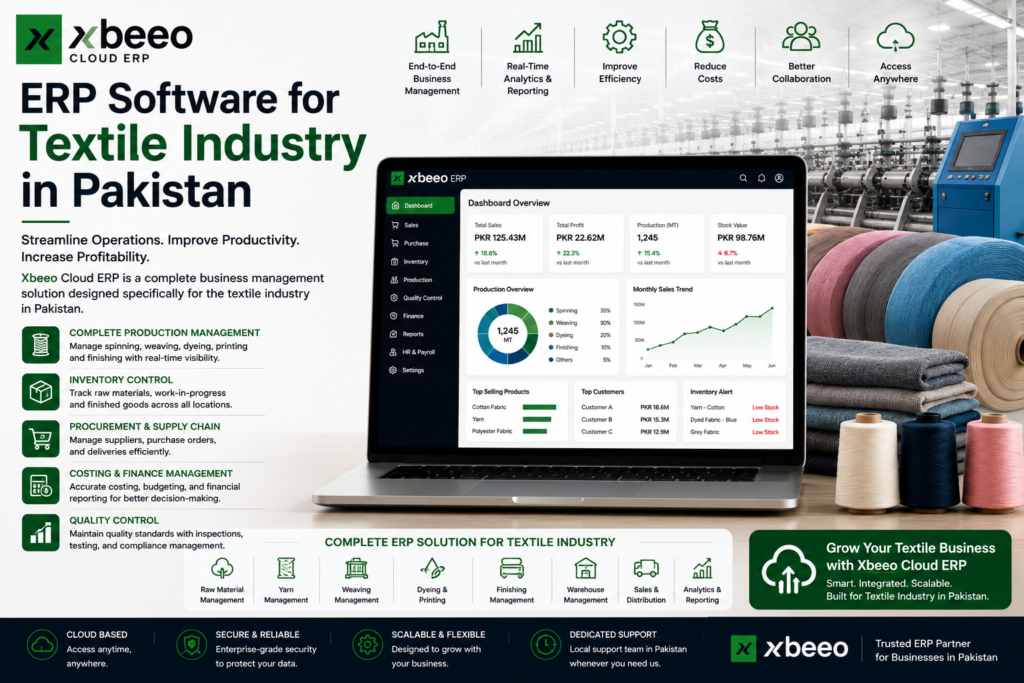
Pakistan’s textile sector is the backbone of its exports and one of its largest employers. From spinning mills in Faisalabad to weaving units in Gujranwala, processing houses in Lahore and garment factories in Karachi and Sialkot, thousands of companies turn cotton into yarn, fabric and finished products every day. Yet many of them still run on registers, Excel sheets and the memory of a few senior people.
This guide explains what ERP software for textile industry businesses in Pakistan should do, stage by stage, and how to pick a system that fits the way your mill or factory actually works.
That approach worked when orders were smaller and margins were wider. Today, buyers want faster deliveries, tighter quality and full traceability, while energy, cotton and labour costs keep rising. A mill that cannot see its real cost per kilogram or per piece is making pricing decisions blind.
This guide explains how ERP software helps textile businesses in Pakistan control materials, production, costing and orders, what features matter most for each part of the textile chain, and how to implement a system without disrupting the factory floor.
Why Textile Businesses Need More Than Accounting Software
Most textile companies already have accounting software. It records sales, purchases and payments well. What it cannot do is follow the material through the factory. It does not know how much yarn went into a lot of greige fabric, how much fabric was lost in dyeing, or how many pieces were rejected at finishing. Those details decide whether an order made money.
An ERP connects the commercial side (orders, purchasing, accounts) with the operational side (stock, production, quality). Every movement of material is recorded against an order or a lot, so cost and wastage are visible while the work is still happening, not months later. If you are unsure of the difference, read ERP vs accounting software.
Common Problems in Pakistani Textile Units
We hear the same issues from textile owners and managers again and again:
- Raw material disappears. Yarn and fabric issued to production do not match what comes back as output. Nobody can say where the difference went.
- Costing is a guess. Prices are quoted on last season’s figures, and the real cost is only known after the order ships.
- Delivery dates slip. Production planning sits in one person’s spreadsheet, and changes in one order push others back without warning.
- Stock records are wrong. The godown has different counts from the system, especially for partly used lots, rolls and shades.
- Job work is hard to track. Material sent to outside dyeing, printing or stitching contractors is followed by phone calls rather than records.
- Quality issues come too late. Rejections are found at final inspection, when the cost has already been spent.
- Export paperwork is heavy. Packing lists, invoices and order details are prepared by hand for each shipment.
These are not signs of a bad team. They are signs that the business has outgrown its tools. Many of the same patterns are described in why businesses struggle without ERP software.
How ERP Fits Each Stage of the Textile Chain
Textile is not one industry but a chain of linked processes. A good ERP is configured around the stages your business actually runs.
Spinning
Spinning mills buy cotton and polyester in large lots and convert them into yarn of different counts. The key needs are lot-wise raw material tracking, blend records, count-wise production, waste tracking at each stage and accurate yarn costing per kilogram. ERP helps compare actual yield with standard yield, so a drop in efficiency is spotted early.
Weaving and Knitting
Weaving and knitting units turn yarn into greige fabric. They need yarn issue against beams or machines, production by loom or machine, fabric roll tracking with length and weight, and costing per metre or per kilogram. Job weaving, where yarn belongs to the customer, also needs separate stock tracking.
Dyeing, Printing and Processing
Processing houses deal with shades, recipes, chemicals and re-processing. ERP records dyes and chemicals consumed per batch, links them to fabric lots, tracks shade results and captures re-dyeing costs. This gives a true processing cost per metre and shows which customers or qualities generate the most rework.
Garments and Made-Ups
Stitching units work with styles, sizes, colours, trims and buyer orders. They need bills of materials per style, fabric and trim issue against cutting, piece-rate or line-wise production tracking, and costing per piece. Order-wise tracking shows how much of each style is cut, stitched, finished and packed.
Trading and Wholesale
Fabric traders in markets like Faisalabad’s Kotwali Road and Lahore’s Azam Cloth Market need quality-wise and shade-wise stock, quick invoicing, credit control and stock across godowns. For them, sales and inventory modules matter more than production. See cloud ERP for distributors and wholesalers.
Key ERP Features for Textile Companies
Lot, Roll and Batch Tracking
Every lot of cotton, cone of yarn or roll of fabric carries its own identity: supplier, count or quality, shade, weight, length and location. When a buyer raises a complaint, you can trace the problem back to the exact lot and supplier. Read more about inventory management in XBEEO.
Bills of Materials and Consumption Standards
Set standard consumption for each product: kilograms of yarn per metre, metres of fabric per garment, grams of dye per kilogram of fabric. ERP compares actual issue with these standards and flags over-consumption by order, machine or department.
Production Planning and Scheduling
Plan production orders against machine capacity and delivery dates. When an urgent order arrives, you can see which orders will be affected before you accept it. See production planning and MRP software for production planning.
Job Work and Outside Processing
Track material sent to outside contractors for dyeing, printing, embroidery or stitching. ERP records what was sent, what came back, what was lost and what is still pending, along with the contractor’s charges.
Order and Style Costing
Collect material, labour, processing, overheads and job work charges against each order or style. Compare estimated cost at quotation with actual cost at completion. This is often the feature textile owners value most, because it shows which buyers and products truly make money.
Quality Control
Record inspections at receiving, in-process and final stages, with defect types and rejection quantities. Over time, quality data shows which suppliers, machines or lines cause the most problems. See quality management ERP.
Procurement and Supplier Management
Raise purchase requests from production needs, get approvals, compare supplier quotations and match bills to receipts. Rate history for cotton, yarn, dyes and chemicals helps you buy at the right time. See procurement and supply chain software.
Export Order Management
Manage buyer orders with styles, sizes and shipment dates, track progress through each stage and prepare commercial invoices and packing lists from the system. Currency, freight and export rebates can be recorded against each shipment.
Payroll for Piece-Rate and Monthly Staff
Textile units often mix monthly salaried staff with piece-rate workers and contractors. ERP calculates payroll from production records and attendance, and posts it to accounts. See the human resource hub.
Finance and Tax
Sales, purchases, production costs and payroll flow into accounts automatically, with sales tax and withholding tax recorded on each transaction. See accounting and finance and FBR-compliant ERP software.
Connecting Inventory and Production
The biggest gains come when stock and production work from the same data. When a production order is released, ERP checks yarn, fabric, dyes and trims against what is in stock and on order. Shortages appear before the line stops, not after. When output is recorded, finished goods stock rises and work-in-progress falls automatically.
This link also reduces overstocking. Many mills hold extra yarn and chemicals “just in case” because they do not trust their records. With reliable, live stock, buying can follow real requirements. Read how ERP prevents stock shortages and overstocking and common inventory problems for practical examples.
Cloud ERP for Multi-Unit Textile Groups
Many textile groups run a spinning unit in one city, weaving in another and a head office in Lahore or Karachi. Cloud ERP gives every unit the same live system without setting up servers at each site. Management sees combined stock, production and financials, while each unit controls its own operations. See ERP for multi-branch businesses and what is cloud ERP.
Connectivity at factory sites is a common concern. Most mills use a primary and backup internet connection with UPS support for network equipment. Our guide on internet and load-shedding backup plans covers the practical setup.
Is Your Textile Business Ready for ERP?
You are probably ready if:
- You cannot say the real cost of an order until weeks after it ships.
- Material reconciliation between issue and output never adds up.
- Production planning depends on one person and one spreadsheet.
- You are adding machines, units or export buyers.
- Buyers are asking for better traceability and reporting.
If several of these apply, read signs your business needs a cloud ERP system and our complete ERP buying guide.
How to Implement ERP in a Textile Unit
Textile implementations fail most often when companies try to switch on everything at once. A phased approach works better:
- Map the process. Walk the floor from raw material receiving to dispatch, and agree how each step should be recorded.
- Start with stock and purchasing. Get raw material, lots and godown stock accurate first. Everything else depends on it.
- Add production and costing. Introduce production orders, consumption standards and costing once stock is reliable.
- Connect sales, export and accounts. Link orders, invoices and financials so the full picture is in one place.
- Train by role. Store keepers, supervisors, planners and accountants each learn only what they need, in Urdu or English.
- Review after go-live. Compare system figures with physical counts and adjust settings in the first months.
Our ERP implementation guide explains each phase, and why ERP implementations fail in Pakistan lists the mistakes to avoid.
What Results to Expect
Textile companies that implement ERP well usually see practical improvements within the first year:
- Material variance becomes visible by order and department, so wastage can be reduced.
- Order costing is available during production, improving pricing for the next order.
- Stock accuracy improves, reducing emergency purchases and dead stock.
- Delivery dates become more reliable because capacity is planned, not guessed.
- Month-end closing is faster because transactions are already posted.
For a closer look at returns, see the ROI of cloud ERP.
How XBEEO Supports Textile Manufacturers
XBEEO is a cloud ERP built for Pakistani businesses, with modules for manufacturing and production, inventory, procurement, sales, HR and finance. For textile companies, we configure lots, qualities, shades, counts, consumption standards and costing around how your factory works. Our team is based in Lahore and supports mills and factories in Faisalabad, Gujranwala and across Pakistan.
If you run a broader manufacturing operation, also see ERP software for manufacturing companies in Pakistan.
Tracking Energy, Overheads and Hidden Costs
In Pakistani textile units, electricity and gas can be among the largest costs after raw material. Yet in many costing sheets they are spread evenly across all products, which hides the truth. A heavy fabric that runs slowly on the loom uses far more energy per metre than a light one, and a dark shade takes longer in the dyeing machine than a pastel.
ERP lets you allocate overheads more fairly, using machine hours, production quantities or departments as the basis. Generator fuel, maintenance spares, packing material and transport can all be charged to the right cost centre. Once these costs are visible by product and order, pricing discussions with buyers are based on facts rather than habit.
Reports Textile Owners Actually Use
A system is only as useful as the answers it gives. These are the reports textile managers rely on most once ERP is in place:
- Order status: each buyer order by stage, from yarn issue to packing, with quantities and expected dates.
- Material variance: standard versus actual consumption by order, machine or department.
- Order profitability: quoted price versus actual cost, including job work and overheads.
- Stock by lot and age: yarn, greige and finished fabric by quality, shade and how long it has been sitting.
- Job work pending: material with outside contractors and how long it has been out.
- Supplier performance: on-time delivery, rate trends and rejection rates for cotton, yarn, dyes and trims.
- Receivables and payables ageing: who owes the mill and whom the mill owes, by due date.
All of these are available from the analytics and reports module, filtered by unit, period or customer.
Textile Hubs We Work With
Faisalabad is the centre of spinning, weaving and home textiles, with many family-run mills managing several units. ERP helps these groups see combined stock and production across sites. See cloud ERP in Faisalabad.
Lahore is home to processing houses, garment exporters and the head offices of many textile groups. Our team is based here and can visit factories for setup and training. See cloud ERP in Lahore.
Gujranwala and Sialkot have strong weaving, knitwear and sports-garment clusters, often with export orders and strict delivery schedules. See cloud ERP in Gujranwala.
Karachi hosts large composite mills and export houses where order management and shipment documentation are critical.
Choosing the Right Textile ERP Provider
Not every ERP is suited to textile. Before you sign, check the following:
- Textile experience. Ask for examples of mills or factories similar to yours.
- Process demo. Ask the provider to show one of your real orders moving from yarn issue to dispatch.
- Lot and shade handling. Make sure the system tracks the attributes your business depends on.
- Costing method. Understand how material, labour, job work and overheads are collected.
- On-site support. Textile floors need hands-on training, not just online videos.
- Phased plan. A credible provider will suggest starting with stock and purchasing, not everything at once.
- Total cost over three years. Include subscription, setup, training, customisation and support. See cloud ERP cost in Pakistan.
To compare the market, see our list of top ERP software providers in Pakistan.
Mistakes Textile Companies Should Avoid
- Loading dirty data. If opening stock is wrong, every report after go-live will be wrong too. Do a proper physical count first.
- Skipping consumption standards. Without standards, ERP can record usage but cannot tell you whether it was too high.
- Leaving supervisors out. The people on the floor must be part of the design, or they will keep using registers.
- Customising too early. Use the standard system for a few months before asking for changes.
- No internal owner. Someone senior must own the project and push for adoption.
Meeting Export Buyer and Compliance Requirements
Most export buyers now ask for more than a good price and on-time shipment. They want proof of where the fibre came from, which chemicals were used in dyeing and how workers were paid. Audits for certifications such as OEKO-TEX, GOTS and social compliance programmes all depend on records that can be pulled up quickly and trusted.
When purchases, lots and production are recorded in one system, traceability stops being a scramble before an audit. You can show which cotton lot went into which yarn count, which dye batch was used on which fabric roll, and which order it shipped against. Chemical purchases can carry their safety data, and wage records for piece-rate and monthly staff are already in payroll.
Quality data matters here too. Inspection results, shade approvals and rejection reasons logged at each stage build a history buyers can review. Our quality management module keeps these checks linked to the order, so nothing lives only in a supervisor’s notebook.
Cost of ERP Software for Textile Industry Units
Cost depends on how many stages you run, how many users need access and how much setup your processes require. A single garment unit with one store and a stitching floor needs far less configuration than a vertically integrated group with spinning, weaving, processing and export documentation.
Cloud ERP usually works on a monthly or yearly subscription per user, plus a one-time fee for implementation, data migration and training. That removes the need to buy servers or hire an in-house IT team. Most textile companies start with inventory, purchasing, production and accounts, then add payroll, quality and export modules once the core is stable.
When comparing quotes, look past the licence price. Ask what is included in implementation, how many training sessions you get, whether costing and job work are standard or custom, and what support costs after go-live. A cheaper system that cannot track lots or wastage properly will cost far more in lost margin than it saves on fees. If you also run a stitching unit, our garments manufacturing system page covers cutting, stitching and finishing in detail.
Frequently Asked Questions
What is textile ERP software?
It is an integrated system that manages purchasing, stock, production, quality, costing, sales and accounts for textile companies, with features such as lot tracking, consumption standards and order costing.
Can ERP handle spinning, weaving, processing and stitching together?
Yes. Each stage can be set up as its own production process, with material moving from one to the next and costs collected along the way.
Does ERP support job work with outside contractors?
Yes. Material sent out for dyeing, printing or stitching is tracked, along with what comes back, losses and contractor charges.
Is cloud ERP suitable for factories with weak internet?
With a backup connection and UPS for network equipment, most factories run cloud ERP reliably. Data stays safe online even during power cuts.
How long does textile ERP implementation take?
It depends on the number of units, processes and the state of your data. A phased approach starting with stock and purchasing is usually faster and safer than a full rollout at once.
Can we start with only a few modules?
Yes. Many textile companies begin with inventory and procurement, then add production, costing and export modules.
Talk to Us About Your Textile Operation
Tell us what you produce, how many units you run and where control is slipping today. We will show you how XBEEO would handle your process using your own examples. Book a free demo or contact our team, call +92 300 7759490 or email info@xbeeo.com.
